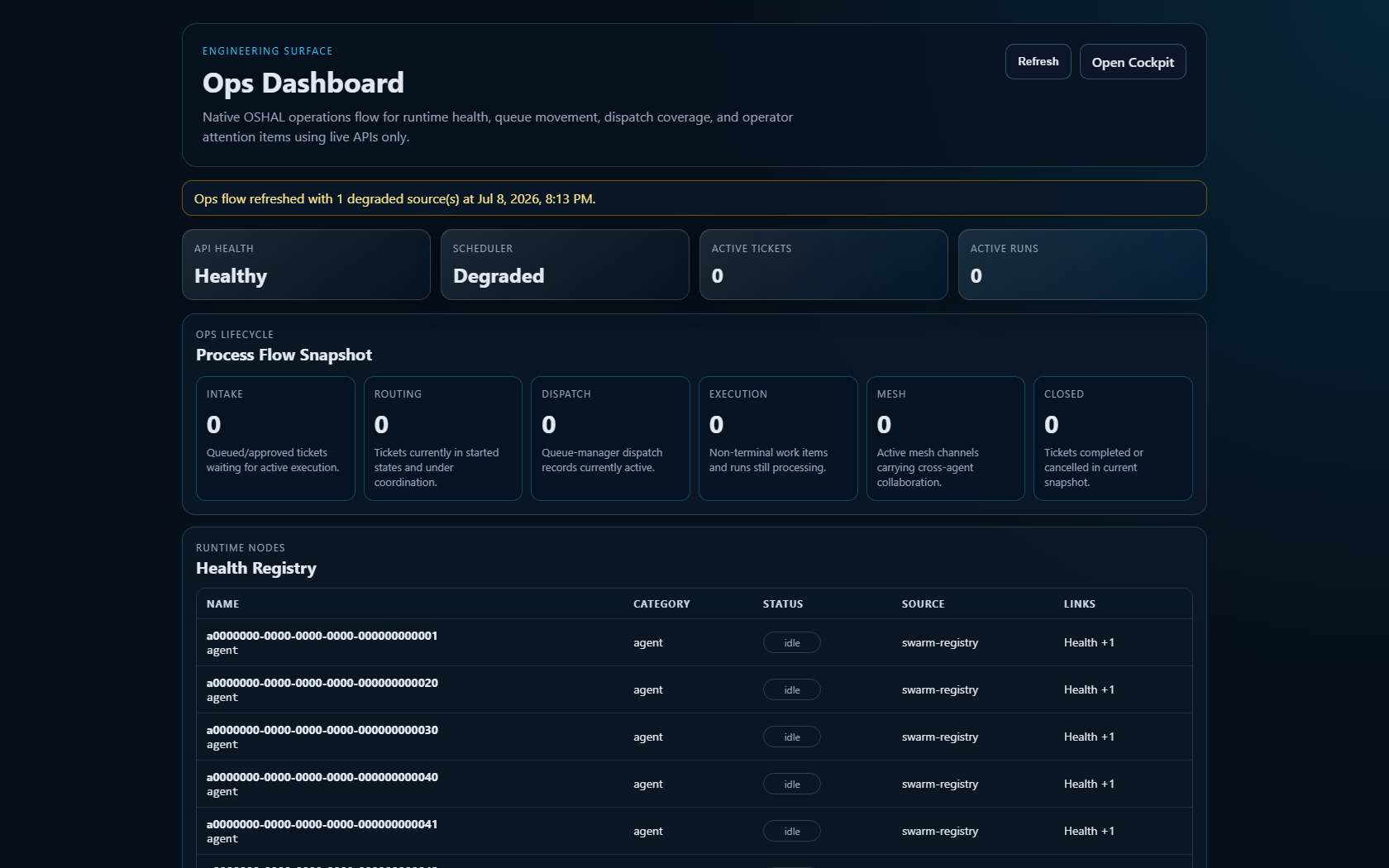
Operations
The stack watches itself, files its own incident tickets and does root-cause analysis on them — with the repair still gated on a human.
The monitoring overlay is wired all the way through to the ticket system. An alert becomes a ticket, the ticket gets root-cause analysis, and the analysis reaches an explicit disposition. The loop closes somewhere you can audit.
A triage stage does storm consolidation, bundles related alerts behind an ordered root-candidate policy, and applies claim, budget, flap and already-resolved gates. That is the difference between a self-healing system and one bad night turning into two hundred tickets nobody reads.
Keep reading
One shell for every app. The left ribbon is drawn from the app you opened, and the URL decides — never a cached preference.
Learn more → Connections310 hand-audited connector specs ship in the repo. Your token is encrypted per user, and the model never sees it.
Learn more → Work routingA request becomes a ticket, a ticket becomes phases, and phases are dispatched to accountable bot identities over durable streams.
Learn more → StateFour stores, each doing the job it is genuinely better at — and one of them is optional on purpose.
Learn more → any-bot40 model providers wired in, hosted or local, on your keys — with a containment boundary that fails closed.
Learn more → ReachA bot is an identity, not a location — and an identity can live on the desktop where your browser is already signed in.
Learn more → InteropAgents that are not yours can be given a scoped door into the swarm — and oshal bots can call out through the same protocol.
Learn more → The wallAuth per route, credentials the model never sees, per-user data scoping, and a fail-closed gate between a commit and the public.
Learn more →